


Tennis Elbow Therapy
Information about tennis elbow from Sepp Baumgartner

Tennis Elbow
Preventive measures
Do not skimp on your technique training. A flawless stroke technique is particularly important. Additional conditioning training alongside tennis is also recommended.
Tennis is an asymmetrical sport, and the muscles are strengthened unevenly. The spine is put under uneven strain, which can cause pain to radiate into the arm. The back, abdominal and shoulder muscles in particular should be trained on both sides.
Warm up before playing.
Choose suitable equipment.
Your coach will be happy to advise you.
Consider the following factors when buying your racket:
- good vibration damping
- Beginners should choose more flexible racket frames
- Choose a grip size that allows at least a little finger to fit between your middle finger and the ball of your thumb
- Choose a good synthetic string or, ideally, play with natural gut string. Beginners should have their rackets strung more loosely than advanced players.
Stretching after training is particularly important. Although training strengthens the muscles, they tend to shorten. This can often lead to muscle cramps or strains and tendon inflammation. So stretch the areas that have been put under the most strain immediately after training, ideally under a warm shower.
Acute tennis elbow
Acute tennis elbow occurs when the irritation is still recent or particularly severe.
The following measures have proven effective for acute tennis elbow:
-
Keep the arm at rest
The longer the symptoms persist, the more prolonged and difficult they are to resolve. Anti-inflammatory treatment is also advisable.
-
Cooling
Cooling with cold running water or ice for two to three minutes as soon as the symptoms appear can have a particularly beneficial effect.
Important: Continue cooling several times a day and stretch the muscles at the same time. After cooling, keep the arm warm, but do not apply artificial heat or massage it, as this will worsen the inflammation.
-
If you are experiencing extremely severe pain, you should always consult a doctor. Milder symptoms that do not subside after several days should also be treated by a doctor.
Take care after immobilisation and particularly after injections. A carefully graduated rehabilitation programme is essential, as a relapse can be very problematic.Only once the pain has largely subsided and your arm is able to bear the strain following rehabilitation exercises should you cautiously return to tennis, ideally under the guidance of a coach.
Chronic tennis elbow
The following tips can help promote healing of chronic tennis elbow:
-
Heat therapy
Heat is particularly important for chronic inflammation. Keep the arm warm during exertion, as well as during the day and at night. Before intense exertion, for example before playing tennis, the muscles should be warmed up with special exercises (see arm exercises below). You can also massage in an ointment that promotes circulation.
-
Active therapy
Train the arm and shoulder muscles daily (see arm exercises). With chronic inflammation, the arm can also be exercised by playing tennis. However, this requires a targeted warm-up and good stroke technique. Daily, measured training, preferably once and no more than twice a day, combined with stretching and cooling afterwards, helps chronic inflammation heal faster than conventional immobilisation.
Warning: Exertion without cooling afterwards aggravates the inflammation! -
Cold-stretching therapy
Immediately after exertion, the muscles and tendons must be stretched and cooled, as an irritated muscle tends to shorten or even cramp, leaving the tendon constantly overloaded.
* How to cool:
First, pre-stretch under a warm shower for about 20 seconds, then stretch further under a cold shower or by rubbing with ice cubes for around two minutes. Cold stretching keeps the muscle long and helps the inflammation subside.
* How to stretch while cooling:
For pain on the outside of the elbow, close your fingers into a fist, straighten your arm and rotate it inwards until your thumb points downwards. For pain on the inside of the elbow, straighten your arm and fingers and rotate your arm outwards until your palm faces upwards. After cooling, keep your arm warm with clothing (e.g. an angora sleeve).
-
Muscle relaxation
Relaxing the muscles in the arm, and especially in the shoulder and cervical spine area, with massages often greatly promotes healing.
-
Healthy diet
A varied diet (low in sugar, salt and fat) and avoiding alcohol and smoking strengthen the body's natural healing powers.
-
Tennis elbow support
For heavier exertion, a special tennis elbow support can relieve the arm. The “Epico-med” support is recommended, as its pressure can be easily adjusted with a Velcro fastener, thereby completely avoiding circulatory problems.
-
More tips
Other treatment options that may have a positive effect on the healing process include professional massages directly at the painful point, acupuncture, reflexology, electrical stimulation, laser, X-ray shockwave therapy and stimulation therapy. As a last resort, when all treatments have been exhausted, surgery remains an option.
Tips and routines
Exercises for daily practice and warming up before a match
Please perform all exercises only at an intensity that causes no more than mild pain!
-
Arm muscles
Alternately bend the affected arm towards your chest and straighten it fully. Use your free hand to provide measured resistance. Repeat each exercise 20-50 times.
-
Finger muscles
Fully straighten your fingers and arms, then bend your arms and make a fist, repeating 50-100 times.
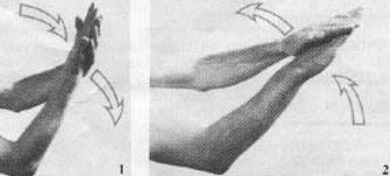

Exercises 1 and 2 for tennis elbow on the outside:
For exercise 1, press the back of your hand from the outside; for exercise 2, press it from the inside with your free hand.Exercises 3 and 4 for tennis elbow on the inside (golfer's elbow):
For exercise 3, press against your palm from the outside; for exercise 4, press from the inside with your free hand. -
Shoulder muscles
Circle your elbows 20-40 times in both directions, on both sides. Hook your free hand around your elbow to intensify the exercise. This exercise places strain on one shoulder while stretching the other.
Duration of the healing process
As a general guide, the healing process takes as long as the illness has lasted so far. In around 95 per cent of cases, chronic inflammation has largely subsided after six months. Around 40 per cent of these people are then free of symptoms. After a further year, the damaged tendon has regenerated and is fully resilient in around 90 per cent of cases.
Finally, it is worth emphasising once again that the most important prerequisite for preventing or healing tennis elbow is flawless stroke technique. So visit a well-trained coach who takes your personal style into account. For example, if you tend to play a backhand slice but execute it incorrectly, you should not switch to topspin, but improve your slice.